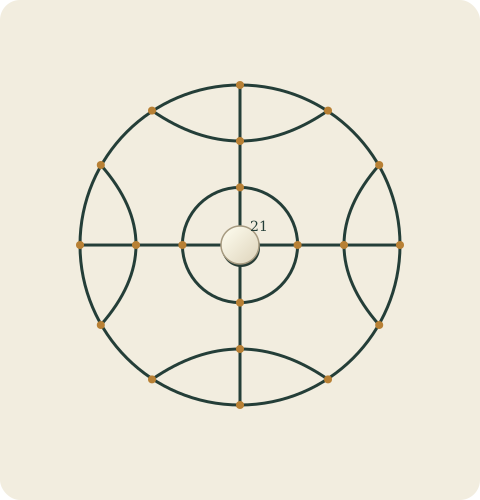
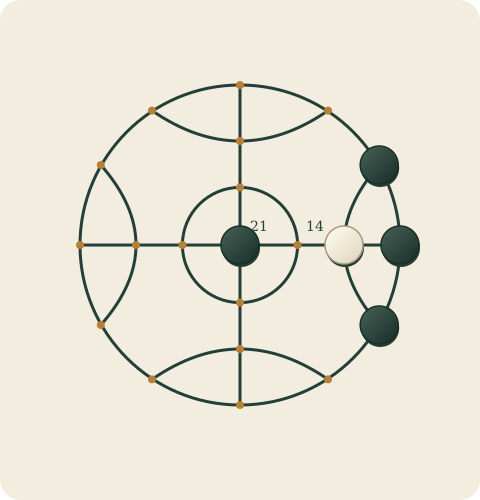
Learn connections, groups, liberties and captures on the 21-point circular board. Twenty illustrated questions cover the last liberty, capture checks and shared empty points.
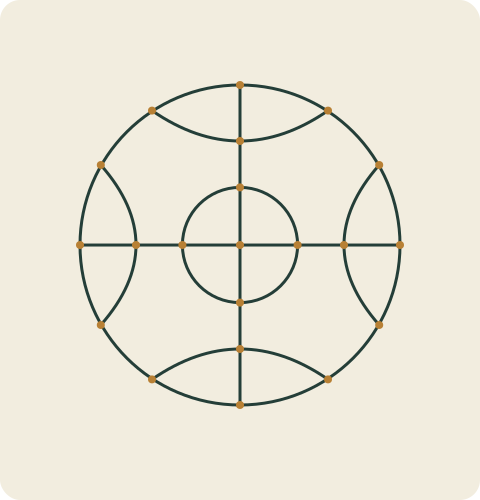
Liberties follow the board’s connections, not visual closeness. Find adjacent empty points before moving. Connected stones of one colour form a group, and an empty point shared by that group counts only once.
After moving along a connection to a legal empty point, remove any adjacent opposing group with no liberties, then check your own group. Captures can free points around a move that first looks surrounded; do not judge it only from the position before moving.
Practise with twenty local positions
The fixed diagrams show only stones relevant to liberties and captures; other stones are omitted, so do not infer a whole-game result. Think about connections, groups and empty points before answering. Each question explains why. The exercises do not alter game saves or leaderboards.
Completed 0/20 questions
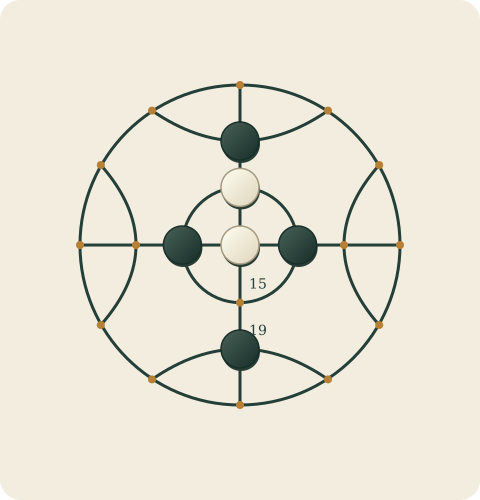
1. Count only connected empty neighbours
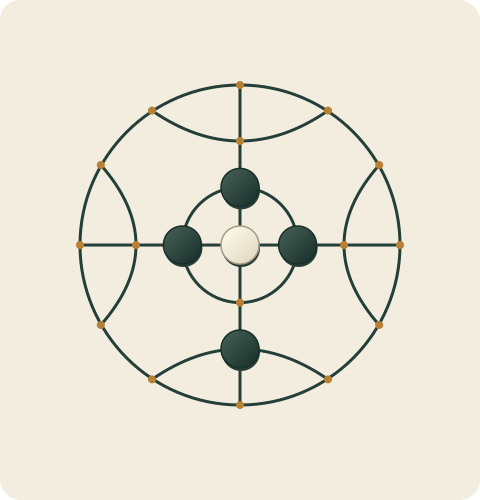
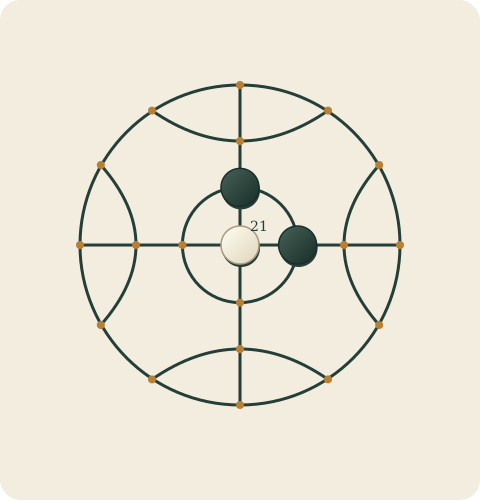
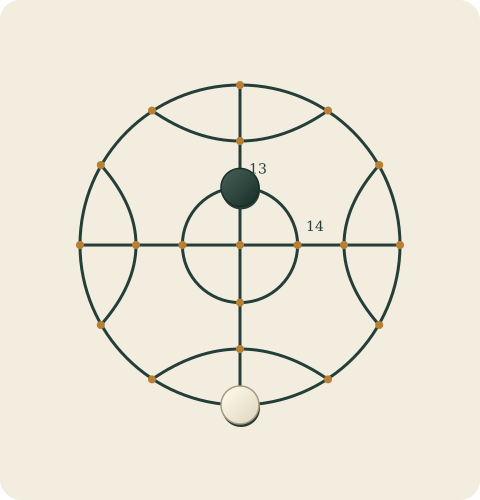
How many liberties remain for the central white stone? Do all the other empty points count?
Completed
To move:Black · Piece positions · Black 13, 14, 16, 19 · White 21
Read the solution
Only one. The upper, left and right neighbours connected to the centre are occupied by Black; only the lower neighbour is empty. Empty points without a direct connection are not this stone’s liberties.
Share this question’s original position, without answers, progress or moves made in the demo.
You can also press and hold the image to save it. Share the position link with the image.
You control both sides. Watermelon positions are partial: explore moves and captures without declaring a full-game result.
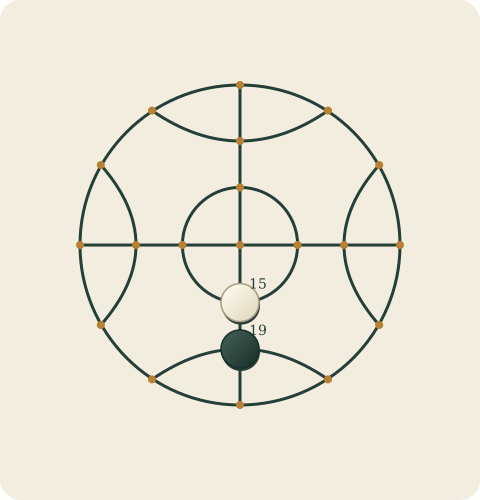
2. Capture first, then check your own liberties
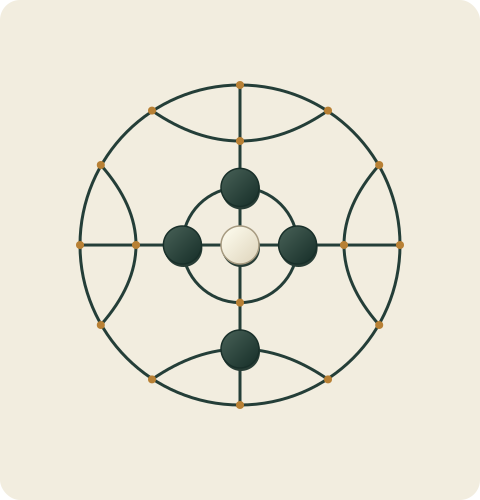
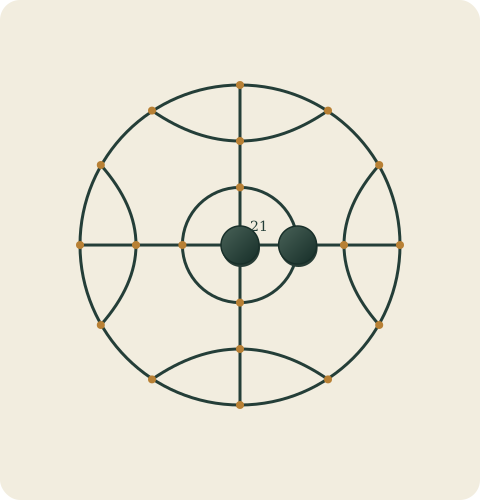
Black to move: advance the lowest black stone one step up the vertical line into White’s last liberty. Is this legal?
Completed
To move:Black · Piece positions · Black 13, 14, 16, 19 · White 21
Read the solution
Yes. The move empties Black’s old point and removes the central white stone, which has no liberties. Resolve the legal capture before checking the resulting black group; surrounding pieces alone do not prove self-capture.
Share this question’s original position, without answers, progress or moves made in the demo.
You can also press and hold the image to save it. Share the position link with the image.
You control both sides. Watermelon positions are partial: explore moves and captures without declaring a full-game result.
3. Shared liberties count once
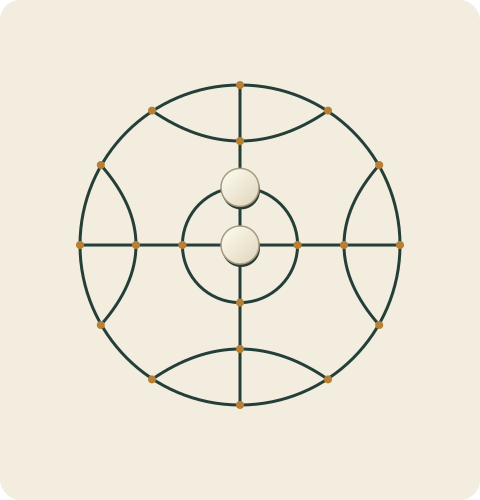
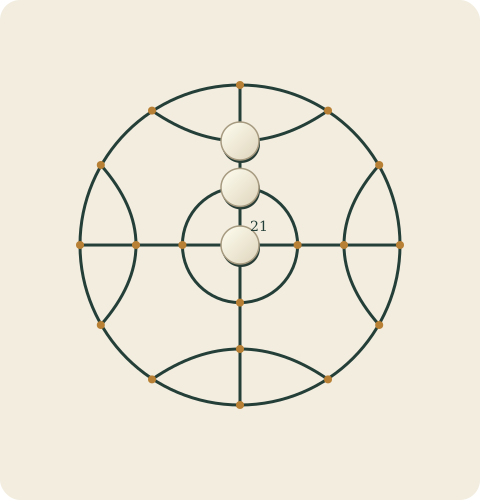
The central and upper white stones are connected. How many liberties does their group have? Judge the group only, not the result of the whole game.
Completed
To move:White · Piece positions · Black — · White 13, 21
Read the solution
Four: the outer neighbour above the upper white stone, the point below the centre, and the shared empty points to the left and right. Each shared point counts once, not once for each stone.
Share this question’s original position, without answers, progress or moves made in the demo.
You can also press and hold the image to save it. Share the position link with the image.
You control both sides. Watermelon positions are partial: explore moves and captures without declaring a full-game result.
4. Group liberties at 21
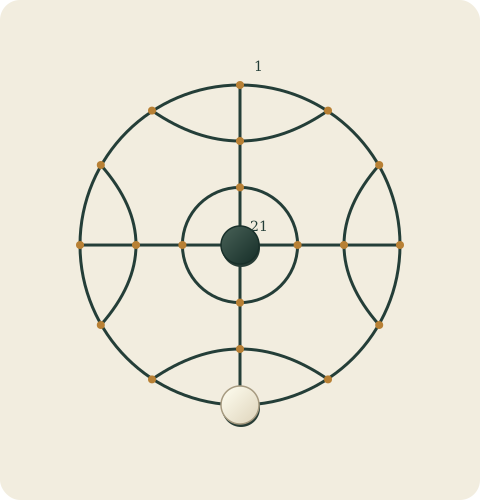
How many liberties does the group at point 21 have? Count connected empty points only, once each.
Completed
To move:White · Piece positions · Black — · White 21
Read the solution
This group has 4 distinct adjacent empty points. Join connected stones of the same colour, then inspect its boundary; distant empties are not liberties.
Share this question’s original position, without answers, progress or moves made in the demo.
You can also press and hold the image to save it. Share the position link with the image.
You control both sides. Watermelon positions are partial: explore moves and captures without declaring a full-game result.
5. Group liberties at 21
How many liberties does the group at point 21 have? Count connected empty points only, once each.
Completed
To move:White · Piece positions · Black 13, 14 · White 21
Read the solution
This group has 2 distinct adjacent empty points. Join connected stones of the same colour, then inspect its boundary; distant empties are not liberties.
Share this question’s original position, without answers, progress or moves made in the demo.
You can also press and hold the image to save it. Share the position link with the image.
You control both sides. Watermelon positions are partial: explore moves and captures without declaring a full-game result.
6. Group liberties at 21
How many liberties does the group at point 21 have? Count connected empty points only, once each.
Completed
To move:Black · Piece positions · Black 14, 21 · White —
Read the solution
This group has 4 distinct adjacent empty points. Join connected stones of the same colour, then inspect its boundary; distant empties are not liberties.
Share this question’s original position, without answers, progress or moves made in the demo.
You can also press and hold the image to save it. Share the position link with the image.
You control both sides. Watermelon positions are partial: explore moves and captures without declaring a full-game result.
7. Group liberties at 21
How many liberties does the group at point 21 have? Count connected empty points only, once each.
Completed
To move:White · Piece positions · Black — · White 13, 17, 21
Read the solution
This group has 6 distinct adjacent empty points. Join connected stones of the same colour, then inspect its boundary; distant empties are not liberties.
Share this question’s original position, without answers, progress or moves made in the demo.
You can also press and hold the image to save it. Share the position link with the image.
You control both sides. Watermelon positions are partial: explore moves and captures without declaring a full-game result.
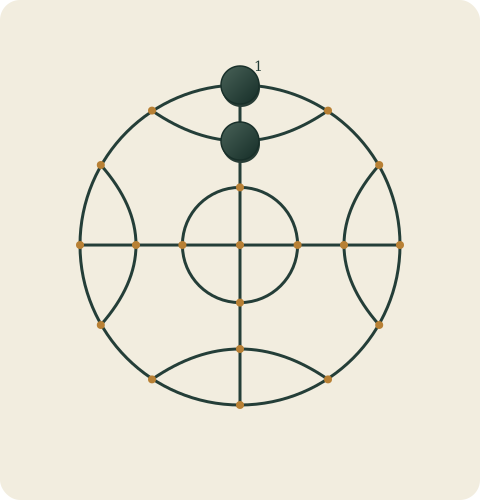
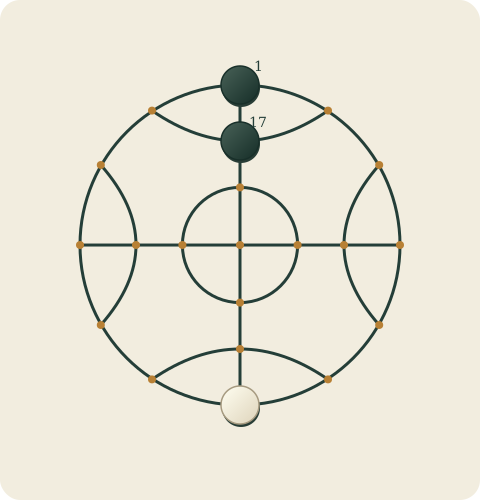
8. Group liberties at 1
How many liberties does the group at point 1 have? Count connected empty points only, once each.
Completed
To move:Black · Piece positions · Black 1, 17 · White —
Read the solution
This group has 3 distinct adjacent empty points. Join connected stones of the same colour, then inspect its boundary; distant empties are not liberties.
Share this question’s original position, without answers, progress or moves made in the demo.
You can also press and hold the image to save it. Share the position link with the image.
You control both sides. Watermelon positions are partial: explore moves and captures without declaring a full-game result.
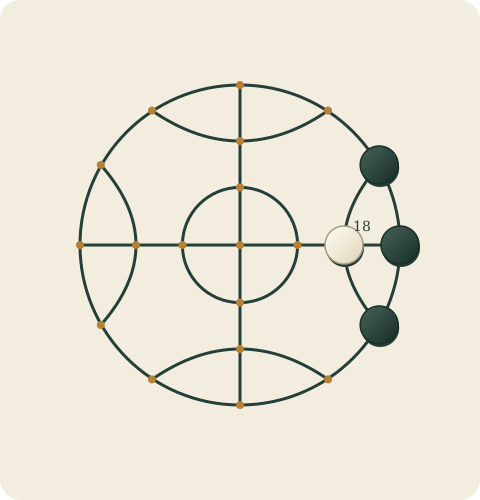
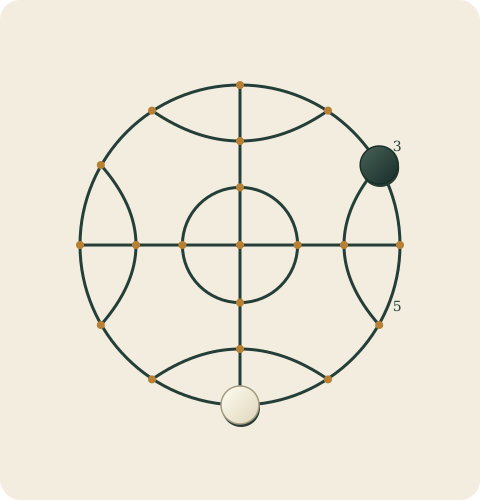
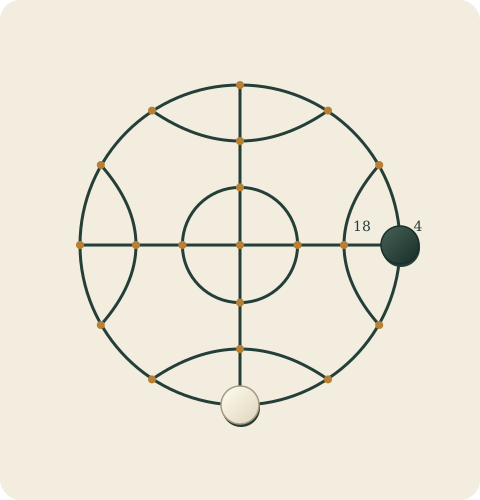
9. Group liberties at 18
How many liberties does the group at point 18 have? Count connected empty points only, once each.
Completed
To move:White · Piece positions · Black 3, 4, 5 · White 18
Read the solution
This group has 1 distinct adjacent empty points. Join connected stones of the same colour, then inspect its boundary; distant empties are not liberties.
Share this question’s original position, without answers, progress or moves made in the demo.
You can also press and hold the image to save it. Share the position link with the image.
You control both sides. Watermelon positions are partial: explore moves and captures without declaring a full-game result.
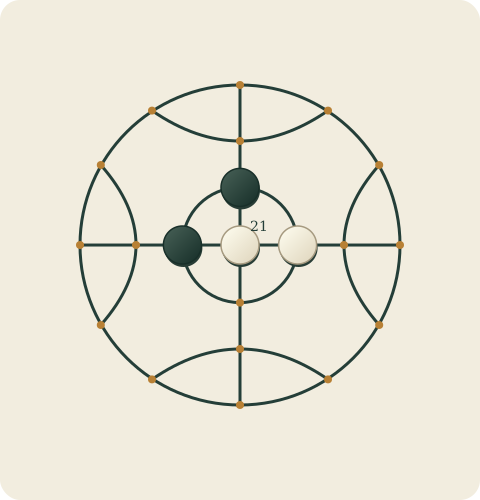
10. Group liberties at 21
How many liberties does the group at point 21 have? Count connected empty points only, once each.
Completed
To move:White · Piece positions · Black 13, 16 · White 14, 21
Read the solution
This group has 2 distinct adjacent empty points. Join connected stones of the same colour, then inspect its boundary; distant empties are not liberties.
Share this question’s original position, without answers, progress or moves made in the demo.
You can also press and hold the image to save it. Share the position link with the image.
You control both sides. Watermelon positions are partial: explore moves and captures without declaring a full-game result.
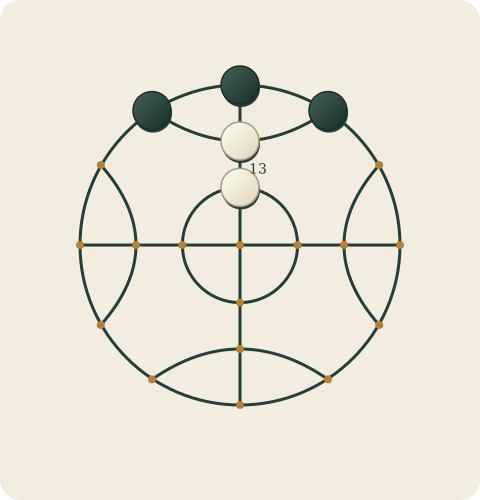
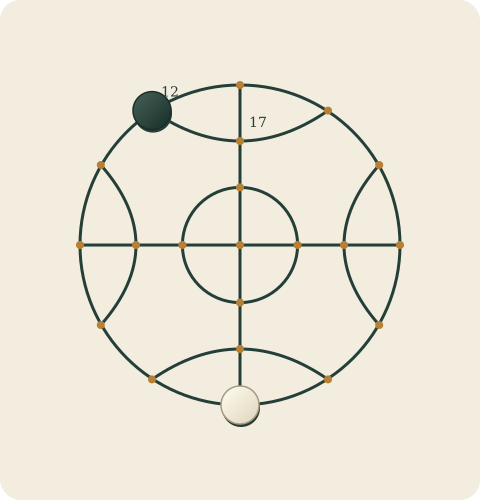
11. Group liberties at 13
How many liberties does the group at point 13 have? Count connected empty points only, once each.
Completed
To move:White · Piece positions · Black 1, 2, 12 · White 13, 17
Read the solution
This group has 3 distinct adjacent empty points. Join connected stones of the same colour, then inspect its boundary; distant empties are not liberties.
Share this question’s original position, without answers, progress or moves made in the demo.