Follow this game’s learning path: Mahjong: Winning Conditions and Rulesets · Open the Mahjong win checker
Prepared by:Jia'an Board & Card Games · Updated
Match example
First check the tile’s source. In Tui Dao Hu, an opponent’s discard can complete your hand if the shape is valid. In Self-Draw Mahjong, you must draw the winning tile yourself; a discard does not count as a self-draw.
Next check the ruleset. In MCR Mahjong, even four sets and a pair must reach eight points without counting flowers. This site’s Tui Dao Hu version does not have that minimum.
Finally check Dingque. This practice uses only characters, circles and bamboo. Choose a missing suit at the start and discard that suit first; you cannot win while tiles of that suit remain in your hand.
Start with the default Tui Dao Hu
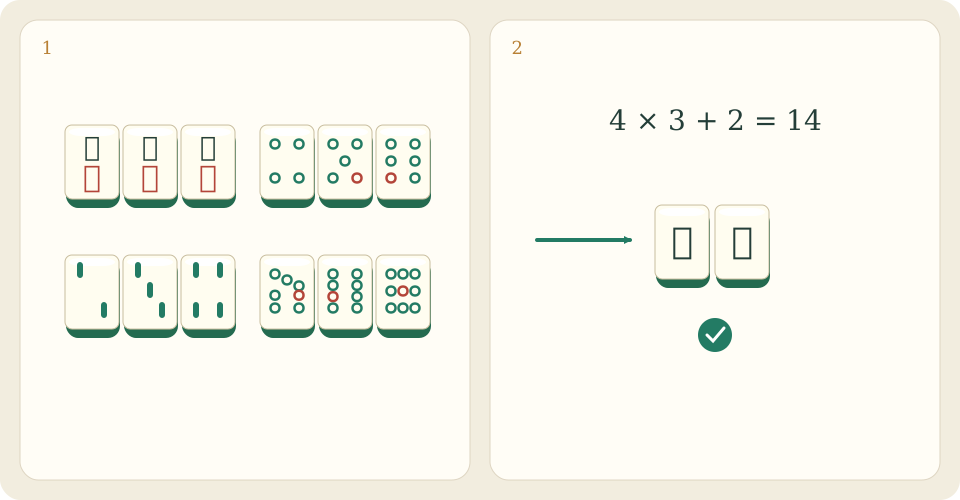
The default here is Tui Dao Hu: 136 tiles with no flowers. Four sets and a pair, or seven pairs, can win. Chow, pung, kong and discard wins are allowed. Learn sequences, triplets and the pair before moving to a scoring-based version; it will be easier to understand when the win button appears.
MCR scoring and self-draw restrictions are different
MCR Mahjong uses 144 tiles, including eight flowers. Flower points do not count towards the eight-point minimum, but are added after you qualify. Self-Draw Mahjong restricts where the winning tile comes from. This site’s version allows pung and kong but no chow, discard wins or robbing a kong. Not every unavailable win is caused by insufficient points.
Dingque practice is not full Blood Battle
This practice uses 108 suited tiles, with no winds, dragons or flowers. Chow is disabled; pung, kong and discard wins are allowed. The first win ends the hand. There is no continued Blood Battle play, kong scoring or end-of-hand ready-hand check. Do not treat these practice rules as universal rules for every regional version.
How to change the ruleset here
Open Mahjong, then go to Settings → Match settings → Ruleset. Read the option descriptions before applying. Changing rules deals a new hand, so decide before your next game. This guide covers the current implementation here; continue with the rules page, scoring guide or game itself.
Game controls
- Select a tile, then choose Discard. On a computer, you can also click the same tile a second time to discard it.
- Choose Hint to select a suggested discard and see improving draws. You confirm the discard.
- You can view the rules, continue to the next round, and switch or turn off background music.
Four rulesets compared: check your current table
| Ruleset | Tiles | Chow | Discard win | Winning requirement |
|---|---|---|---|---|
| Tui Dao Hu | 136 | Yes | Yes | Complete hand; no point minimum |
| MCR Mahjong | 144 | Yes | Yes | Complete hand; 8+ points excluding flowers |
| Self-Draw Mahjong | 136 | No | No | Complete the hand with your own draw |
| Sichuan Dingque Practice | 108 | No | Yes | Clear the missing suit, then complete the hand |
On a narrow screen, scroll the table sideways. Ruleset names stay visible.
Allowing a discard win only permits that source of the winning tile. Your hand must still meet the shape, scoring and missing-suit conditions. This table describes this site’s versions only.