Jia'an · Jungle (Dou Shou Qi)
Play Jungle on a 7×9 board. Use animal ranks, rivers, traps and dens to outplay your opponent.
Jia'an · Go (9, 15 & 19 lines) · Beginner's Guide
Use 9×9 diagrams to see how two real eyes keep a group alive, how a false eye can fail, and one example of seki with a shared liberty.
Prepared by:Jia'an Board & Card Games · Updated
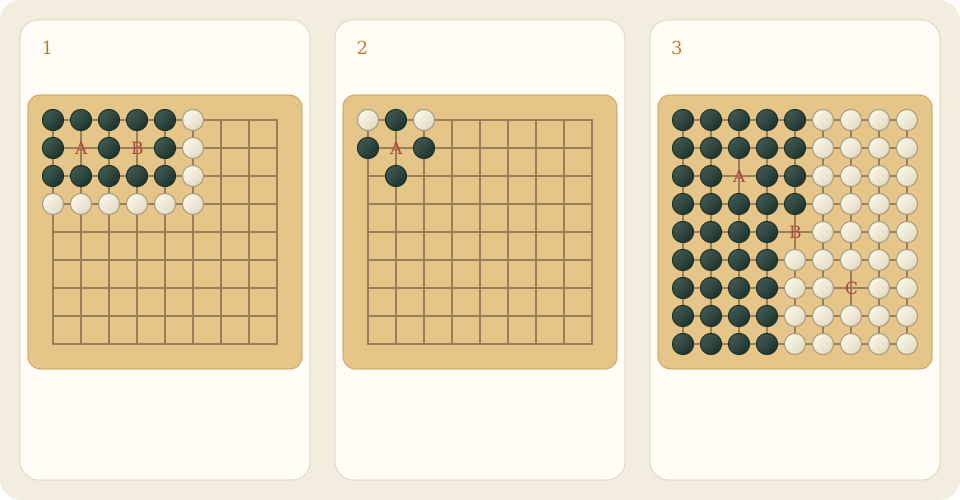
Treat stones of one color connected horizontally or vertically as a group, then count adjacent empty points. An eye is protected space inside a group. Even when an empty point has friendly stones all around it, check that those surrounding stones are safely connected.
In Diagram 1, A and B are two separate real eyes for Black. White cannot capture Black by playing in either one, and the white stone would have no liberties, so the move is illegal suicide. Black does not need to fill its own eyes to protect the group.
A in Diagram 2 appears surrounded by black stones, but the upper stone has only A as a liberty. White can play at A, capture that stone and gain liberties. A therefore cannot simply be counted as a safe real eye: check the actual capture.
Two connected empty points are different from two separate eyes. If White can play at one without suicide and then capture through the remaining point, two empty points alone do not prove life. In Diagram 1, the same black group separates the two eyes, and White cannot play in either first.
In Diagram 3, A is Black's private eye, C is White's private eye, and B is a shared liberty. If Black fills B first, White can capture at A; if White fills B first, Black can capture at C. Neither wants to fill B. This is one form of seki; sharing liberties alone does not always mean seki.
Seki means two local groups can coexist; it does not decide the whole game. Check further if there are outside liberties, connections, ko fights or forcing moves. A group without two eyes is not automatically dead, and one local diagram is not a result for the whole board.
Here, two consecutive passes end the game and score the current board. The game does not automatically mark or remove apparently dead stones. Capture any stones you want removed before passing. These diagrams explain life, death and legal moves; they do not replace endgame counting or import another rule set's seki scoring.
| Diagram | Reason |
|---|---|
| Diagram 1: two real eyes | White cannot play in either eye first |
| Diagram 2: a false eye | White at A captures one stone first |
| Diagram 3: seki | The side that fills shared liberty B first can be captured |
Basic concepts reference: British Go Association: liberties, eyes and seki. The diagrams are original to this site, and captures have been checked against our game code. See our endgame guide for scoring.
Ready for something different? Open another game below, or read its rules before you begin.
Play Jungle on a 7×9 board. Use animal ranks, rivers, traps and dens to outplay your opponent.
Command twenty-five army pieces, move along railways, clear mines with engineers and capture the enemy flag.
Move or chain jumps across a six-pointed star board. Fill the opposite camp before your opponent.